

TL;DR:
- Ensuring high-purity peptides with batch-specific COAs is crucial for reproducible research outcomes.
- Proper documentation, verification upon receipt, and clear labeling prevent costly experiment failures.
- Selecting reputable suppliers who provide transparent quality control safeguards experimental integrity.
Inconsistent purity, missing certificates of analysis, and opaque checkout processes have derailed more experiments than bad protocols ever will. If you’ve spent hours tracking down a peptide supplier only to receive a product with no batch documentation, you already know the frustration. The good news is that ordering high-purity peptides doesn’t have to be a gamble. This guide walks you through every stage of the process, from clarifying your research objectives to verifying your shipment on arrival, so you can protect your data, your budget, and your experimental integrity.
Table of Contents
- Understand your research needs and peptide options
- Gather your ordering requirements and prepare documentation
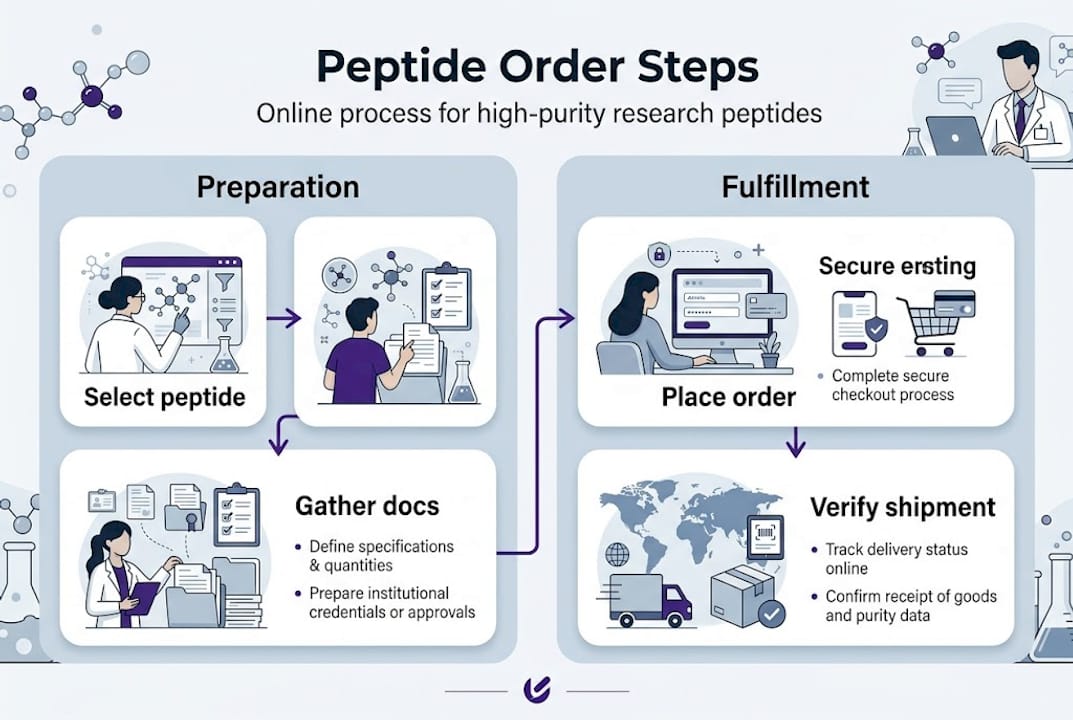
- Follow the ordering process step by step
- Verify shipment and product quality upon arrival
- What most guides miss about safe peptide ordering
- Order high-purity peptides with confidence
- Frequently asked questions
Key Takeaways
| Point | Details |
|---|---|
| Clarify your needs | Define your research or performance goals to choose the right peptide and order details. |
| Prepare documentation | Have all legal, shipping, and compliance information ready before you order. |
| Order methodically | Use a structured, step-by-step approach online to minimize mistakes and delays. |
| Verify upon arrival | Always check for COAs, batch numbers, and any shipment issues immediately. |
| Prioritize transparency | Choose trusted suppliers and keep quality and compliance at the forefront of every order. |
Understand your research needs and peptide options
Before you place a single order, you need to know exactly what you’re buying and why. Vague goals lead to wrong peptides, wasted reagents, and results you can’t reproduce. Start by writing down your specific research or biohacking objective: are you targeting recovery acceleration, growth hormone secretion, cognitive enhancement, or longevity pathways? Each goal maps to a distinct peptide class.
Here’s a quick overview of the most common categories:
- Growth hormone secretagogues (e.g., GHRP-2, CJC-1295, Ipamorelin): stimulate endogenous GH release, used in performance and anti-aging research
- Healing and repair peptides (e.g., BPC-157, TB-500): studied for tissue regeneration, gut repair, and injury recovery
- Metabolic peptides (e.g., Tirzepatide, Retatrutide): target GLP-1 and GIP receptors, relevant to metabolic and weight research
- Reproductive and hormonal peptides (e.g., Kisspeptin-10): modulate the hypothalamic-pituitary axis, relevant to fertility and hormonal research
- Cognitive enhancers (e.g., Selank, Semax): explored for neuroprotection and cognitive performance
Once you’ve matched your goal to a class, drill into the specs. Purity standards matter enormously. For most experimental applications, you want 98% or higher. GMP-certified synthesis adds another layer of confidence. Also check whether the peptide requires lyophilized storage, what the reconstitution vehicle is (bacteriostatic water vs. acetic acid), and how long it remains stable once reconstituted. These aren’t administrative details; they directly affect your data quality.
| Peptide | Primary use | Typical purity target | Storage |
|---|---|---|---|
| BPC-157 | Tissue repair, gut health | 98%+ | Lyophilized, 2-8°C |
| GHRP-2 | GH secretion | 98%+ | Lyophilized, freezer |
| CJC-1295 + Ipamorelin | GH pulse amplification | 98%+ | Lyophilized, 2-8°C |
| Tirzepatide | Metabolic research | 99%+ | Lyophilized, 2-8°C |
| Kisspeptin-10 | Hormonal axis research | 98%+ | Lyophilized, freezer |
For a deeper breakdown of peptide classes and mechanisms, understanding peptide types is a useful starting point. If you’re specifically evaluating hormonal peptides, the KISSPEPTIN-10 details page gives you a concrete example of what a well-documented product listing looks like.
Key factors when selecting therapeutic peptides for research include purity verification, sequence accuracy, and documented synthesis methods. These aren’t optional checkboxes; they’re the foundation of reproducible science.
Pro Tip: Always request or download the certificate of analysis (COA) before purchase, not after. A legitimate supplier will have it readily available, linked directly to the batch you’re buying.
Gather your ordering requirements and prepare documentation
With your peptide selected, the next step is getting your documentation and ordering information in order before you hit checkout. Skipping this step is one of the most common reasons orders get delayed, flagged, or returned.
Here’s what you need ready before you start an order:
- Peptide specifications: exact name, sequence, molecular weight, quantity (mg), and purity grade
- Shipping details: full legal name, verified address, and any import restrictions relevant to your jurisdiction
- Payment method: a traceable method (credit card or institutional purchase order) that creates a clear paper trail
- User credentials: supplier account login, institutional email if required
- Research affiliation or intended use statement: some suppliers require a brief description of your research purpose
Compliance isn’t just a legal formality. It’s what separates a traceable, defensible purchase record from a liability. In the US, peptides sold for research use are legal to purchase, but they must be labeled “not for human consumption” unless prescribed by a licensed practitioner. Ordering outside those parameters creates risk for you and undermines the integrity of your research program.
“A purchase record is only as strong as the documentation behind it. Incomplete forms, mismatched peptide names, and unverified addresses are the three fastest ways to compromise an order and your credibility as a researcher.”
Common mistakes at this stage include submitting forms with the peptide’s brand name instead of its chemical name, entering a shipping address that doesn’t match your billing information, and failing to save a copy of your compliance acknowledgment. These errors are avoidable with five minutes of preparation.
For reference, peptide order compliance documentation requirements are clearly outlined on well-structured product pages. Reviewing a product like Tirzepatide gives you a practical example of necessary documentation and standards a serious supplier will expect you to acknowledge before checkout.
Follow the ordering process step by step
Once your documentation is ready, the actual ordering process is straightforward if you follow it in sequence. Rushing through checkout is where most errors happen.
- Create your supplier account. Use an institutional or dedicated research email. Enable two-factor authentication if available.
- Search for your peptide by exact name. Verify the sequence, purity percentage, quantity, and batch availability on the product page.
- Download the COA before adding to cart. Confirm the batch number matches what’s listed and that the purity meets your threshold.
- Add to cart and review. Check quantity, unit size, and any bundled items you didn’t intend to include.
- Enter shipping details carefully. Match the address exactly to your registered location. Errors here cause customs delays.
- Select your payment method. Use a traceable option. Some suppliers accept institutional purchase orders, which create the clearest audit trail.
- Review the full order summary. Confirm peptide name, purity, quantity, price, and shipping method before submitting.
- Submit and save confirmation. Print or save the confirmation email and attach the COA to the same folder immediately.
Best practices for ordering peptides for research emphasize that documentation at point of purchase is non-negotiable for reproducibility.
| Step | Action | Documentation required |
|---|---|---|
| Account creation | Register with valid email | Institutional affiliation (if required) |
| Product selection | Verify sequence and purity | COA download |
| Checkout | Enter shipping and billing | Compliance acknowledgment |
| Payment | Use traceable method | Receipt or PO number |
| Confirmation | Save order summary | Order number and COA |
Once your peptide arrives, you’ll need to reconstitute it correctly. Bookmark the peptide reconstitution guide now, before you need it under time pressure.
Pro Tip: Save your COA and order confirmation in the same labeled folder, named by peptide and batch number. When you’re troubleshooting an experiment six months later, you’ll thank yourself.
Verify shipment and product quality upon arrival
Your package arriving intact is not the finish line. It’s the starting point for quality verification. Skipping this step is where even experienced researchers leave themselves exposed.
Start with the packaging itself. Look for:
- Intact seals on vials and outer packaging
- No signs of tampering, moisture damage, or temperature excursion indicators triggered
- All items listed on the packing slip are physically present
- Batch numbers on vials match the COA you downloaded at purchase
- Expiration or manufacture dates are clearly printed and within acceptable range
Next, cross-reference the COA. The batch number on the vial must match the COA exactly. The purity percentage should meet or exceed what you ordered. If the supplier uses third-party verification (Janoshik, for example), the lab report should be accessible via a QR code or direct link.

Reliable peptide suppliers provide batch-specific third-party lab results, not generic certificates that apply to an entire product line. That distinction matters. A COA without a specific batch number is essentially meaningless for research traceability.
Statistic worth noting: up to 25% of online peptide orders may arrive without a valid, batch-specific COA when sourced from unvetted suppliers. That’s a significant risk if your experimental outcomes depend on known purity.
If anything is wrong, act immediately. Contact supplier support with photos of the packaging, the vial, the packing slip, and your order confirmation number. Delays in reporting damage or discrepancies can void replacement or refund policies.
What most guides miss about safe peptide ordering
Most ordering guides stop at “click confirm and wait for delivery.” That’s where the real risk begins, not ends.
The temptation to prioritize price and speed is real, even for serious researchers. A supplier offering 20% lower prices and two-day shipping sounds appealing until your experiment fails and you can’t determine whether the variable was your protocol or your peptide. Reproducibility depends on knowing your inputs are consistent and verified.
What we’ve seen repeatedly is that researchers who skip post-purchase verification are the ones who end up repeating experiments at far greater cost than they saved upfront. The COA isn’t paperwork; it’s your experimental control.
“Quality assurance doesn’t end when you click ‘buy.’ It’s an ongoing practice that covers every batch, every shipment, and every reconstitution.”
Supplier transparency is the variable most guides ignore entirely. Does your supplier publish third-party lab results by batch? Do they respond to quality disputes? Do they update their catalog when a batch fails internal QC? These questions separate a vendor from a research partner. Process discipline, applied consistently, is what makes your data defensible.
Order high-purity peptides with confidence
If you’ve followed this guide, you’re already ahead of most researchers placing orders today. The next step is finding a supplier whose standards match your own.
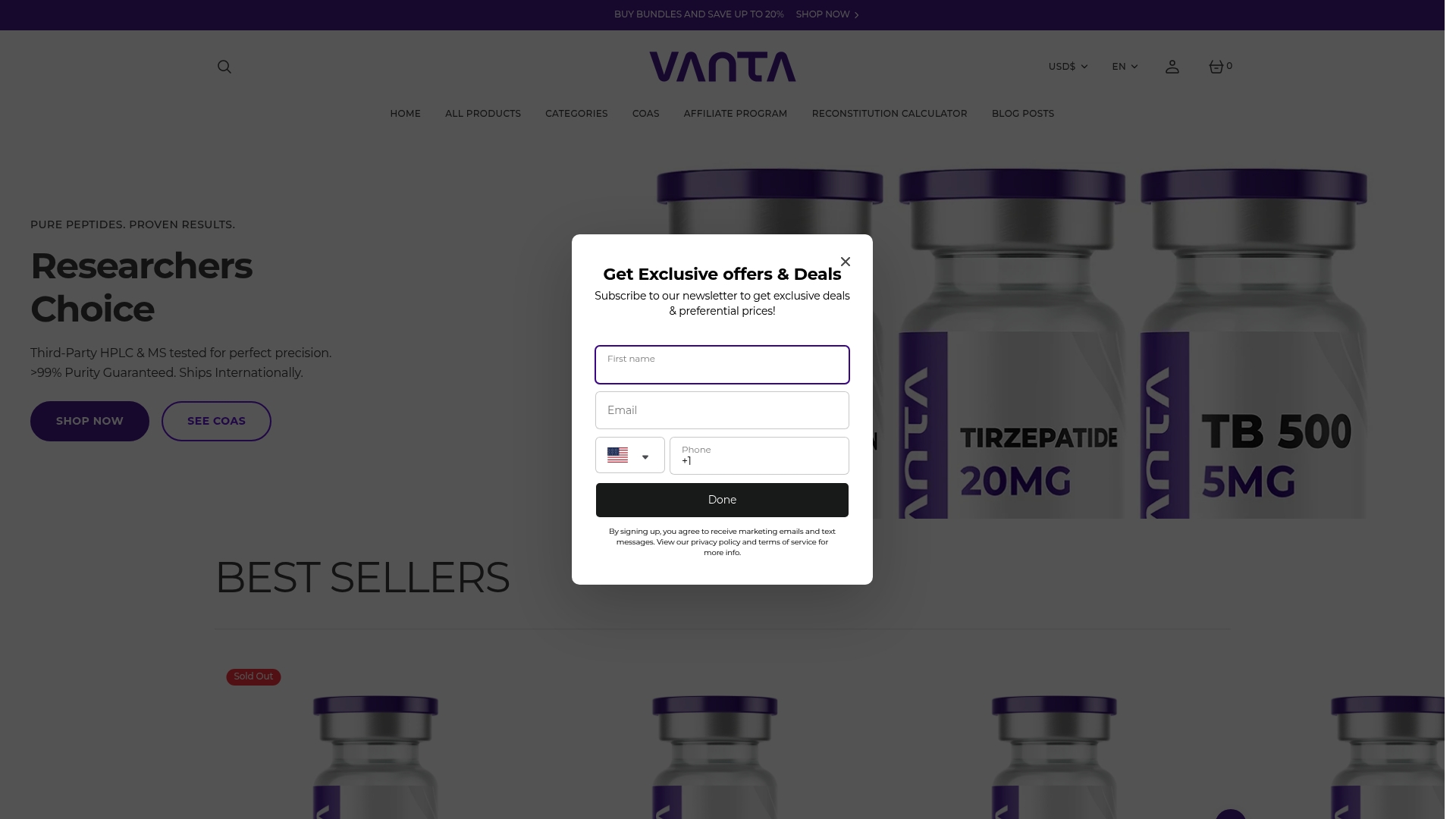
VANTA Peptides is built around the principle that purity isn’t a marketing claim; it’s a verifiable standard. Every product in the catalog is backed by Janoshik third-party verification, with 99%+ purity as the baseline. Whether you’re starting with a well-characterized peptide like BPC 157 or working through a more complex protocol, the resources are here to support you. Explore more about peptides to match your goals to the right compound, and use the reconstitution calculator to prepare your peptides accurately before your first experiment.
Frequently asked questions
What documents do I need to order research peptides?
Most suppliers require your research affiliation, a statement of intended use, and acknowledgment of compliance standards for ordering peptides. Some may also request institutional credentials depending on the compound.
How do I confirm peptide quality when my shipment arrives?
Match the batch number on the vial to your COA, confirm purity meets your specified threshold, and verify third-party lab results are batch-specific rather than generic product-level documents.
Is it legal to buy peptides for personal research?
In the US, peptides labeled for research use are legal to purchase; they are not for human consumption unless prescribed by a licensed practitioner, and buyers are responsible for compliance with applicable regulations.
What should I do if my order is incorrect or damaged?
Contact supplier support immediately with photos of the packaging, the vial, and the packing slip, along with your order confirmation number, to initiate a resolution or reshipment request.
Why do reconstitution calculators matter in peptide research?
A reconstitution calculator eliminates manual dosing errors by computing exact solvent volumes needed for your target concentration, which directly affects the reliability of your experimental results.